Aleister Crowley: Life, achievements, conflicts, decline, death, and legacy
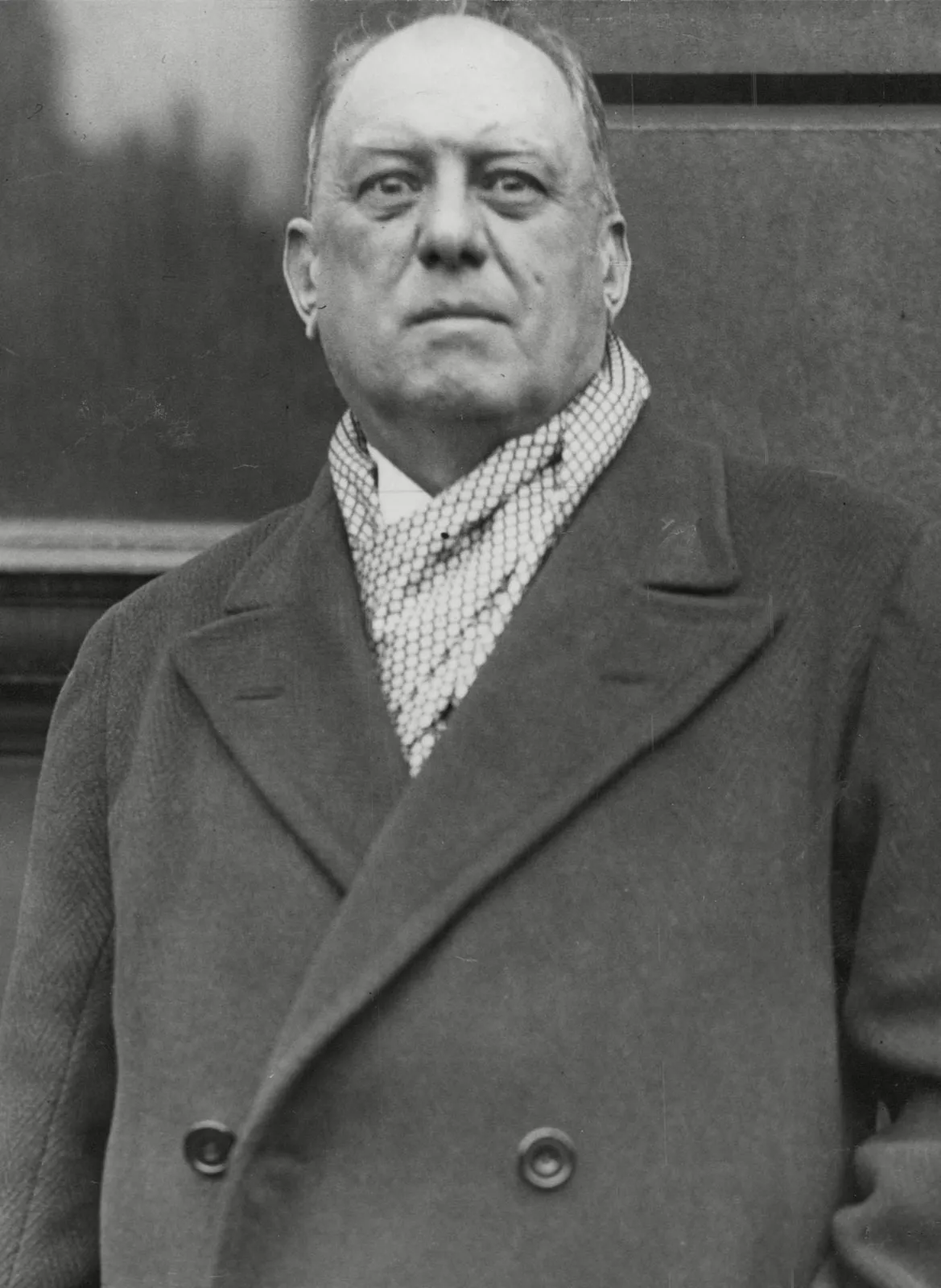
Aleister Crowley was an English occultist, writer, mountaineer, ceremonial magician, religious founder, and professional manufacturer of scandal. During his lifetime, newspapers portrayed him as a satanic monster. Some admirers treated him as a spiritual prophet. The historical Crowley was neither quite the supernatural villain nor the enlightened master presented by those camps.
He was extraordinarily intelligent, widely read, creative, disciplined in some areas, reckless in others, and frequently destructive toward both himself and the people around him. His greatest accomplishment was not performing miracles or commanding demons, despite the theatrical advertising. It was assembling several existing mystical, magical, philosophical, and religious traditions into a new system called Thelema, which survived him and became highly influential within modern Western occultism.
Early life and family
Crowley was born Edward Alexander Crowley on October 12, 1875, in Royal Leamington Spa, England. His family was wealthy through the brewing business, although his father had retired from it before Crowley’s birth. His parents belonged to the Plymouth Brethren, a strict fundamentalist Christian movement that regarded much of ordinary society as corrupt or sinful. Wikipedia
His father, Edward Crowley, was a traveling preacher and appears to have been the parent Crowley loved most. His father died when Crowley was eleven. That death seems to have been psychologically decisive. Crowley increasingly rejected his mother’s religion, its sexual repression, and its rigid division between holiness and wickedness.
His mother reportedly called him “the Beast,” referring to the Beast in the Book of Revelation. Crowley eventually adopted the insult as part of his identity, calling himself “The Great Beast 666.” This was partly religious symbolism, partly rebellion, and partly branding. Crowley understood something that modern celebrities and internet provocateurs would later rediscover: public outrage is still publicity.
He attended several schools and eventually entered Trinity College, Cambridge, in 1895. He studied philosophy and later English literature but left without completing a degree. At Cambridge he wrote poetry, played chess seriously, climbed mountains, explored his sexuality, and became increasingly interested in mysticism and the occult. His relationship with Herbert Charles Pollitt, a theatrical performer and prominent Cambridge aesthete, strongly influenced Crowley’s literary interests and his growing identification with the Decadent movement. Wikipedia
Crowley was bisexual at a time when sexual relationships between men were criminalized in Britain. His sexuality later became intertwined with his religious experiments, particularly his belief that sexual energy could be employed in magical or mystical practice.
Mountaineering and early successes
Before Crowley became notorious as an occultist, he earned genuine respect as a mountaineer.
He participated in the 1902 expedition to K2, led by Oscar Eckenstein. It was the first serious expedition to attempt the mountain, and the party reached an altitude that remained unsurpassed on K2 for roughly two decades. Crowley also participated in the controversial 1905 Kanchenjunga expedition. Although neither expedition reached the summit, they were significant achievements during an era when high-altitude climbing equipment and medical knowledge were primitive. National Portrait Gallery
Crowley was physically capable, courageous, and technically innovative. He favored climbing without guides and criticized the overly formal traditions of British mountaineering. Even people who regard most of his occult career as theatrical nonsense generally acknowledge that he was a serious climber.
The Kanchenjunga expedition, however, also revealed some of his worst qualities. Crowley quarreled bitterly with the other climbers. When several members and porters were caught in a deadly avalanche, Crowley did not participate meaningfully in the rescue effort. He claimed that they had ignored his warnings, a response that reinforced his reputation for coldness and vindictiveness.
The Golden Dawn and ceremonial magic
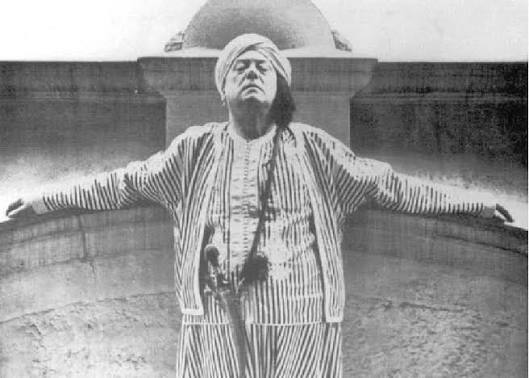
In 1898, Crowley joined the Hermetic Order of the Golden Dawn, one of the most important occult organizations of the nineteenth century. The Golden Dawn combined ceremonial magic, astrology, alchemy, Tarot, Rosicrucianism, Christian mysticism, and interpretations of Jewish Kabbalah into a graded initiatory system.
Crowley learned quickly and advanced rapidly through the order. He studied under figures including Samuel Liddell MacGregor Mathers and Allan Bennett. Bennett also introduced him to Buddhist and yogic practices, which Crowley later incorporated into his own system.
Crowley’s relationship with the Golden Dawn became a prolonged organizational catastrophe, as secret societies apparently possess all the political tranquility of an angry condominium board. Several members, including poet W. B. Yeats, opposed Crowley’s advancement. They disliked his behavior, reputation, and allegiance to Mathers.
In 1900, the conflict culminated in Crowley attempting to seize the order’s London headquarters on Mathers’s behalf while wearing ceremonial clothing. Legal action followed, Mathers lost control, and the Golden Dawn fragmented. Crowley later portrayed the episode as magical warfare. From a less enchanted perspective, it was an institutional power struggle conducted by intelligent adults in elaborate robes.
Marriage, children, and The Book of the Law
In 1903, Crowley married Rose Edith Kelly, the sister of painter Gerald Festus Kelly. The marriage began impulsively but initially appears to have involved genuine affection.
During a trip to Cairo in 1904, Rose entered altered states and told Crowley that the Egyptian god Horus was trying to communicate with him. Crowley performed rituals to investigate her claims. On April 8, 9, and 10, he said that he received the dictated text of Liber AL vel Legis, commonly called The Book of the Law.
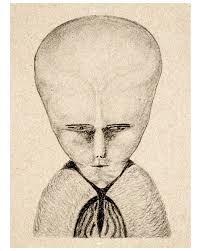
Crowley attributed the voice to an entity named Aiwass. Whether he believed Aiwass was an external supernatural intelligence, part of his deeper mind, or something between those categories varied across his writings. For Crowley and later Thelemites, however, the experience marked the beginning of a new spiritual age, the Aeon of Horus. Wikipedia
The book’s best-known declaration is:
“Do what thou wilt shall be the whole of the Law.”
This is frequently interpreted as permission to do whatever one feels like doing. That is not quite what Crowley meant. In Thelema, each person supposedly possesses a True Will, meaning their deepest purpose or proper course through life. The goal is to discover and enact that Will without being controlled by social conditioning, compulsive desire, fear, or imitation.
The corresponding phrase, “Love is the law, love under will,” places love within that purposeful structure.
Crowley and Rose had two daughters. Their first, Lilith, died of typhoid in 1906 while Crowley was away. Crowley blamed Rose’s alcohol use and neglect, though his own prolonged absences and unstable lifestyle also contributed to the marriage’s deterioration. Their second daughter, Lola Zaza, survived into adulthood.
Rose developed severe alcoholism, and the marriage ended in divorce in 1909. Crowley arranged the divorce on the grounds of his own adultery, apparently to protect Rose from greater public humiliation. She was later institutionalized.
Their relationship demonstrates a recurring feature of Crowley’s life: he could show loyalty or tenderness, but his grand spiritual projects repeatedly took priority over ordinary responsibilities.
Founding Thelema and the A∴A∴
In 1907, Crowley and George Cecil Jones established the A∴A∴, a magical initiatory organization intended to teach Crowley’s evolving system. It drew heavily from the Golden Dawn but placed greater emphasis on individual spiritual experience, disciplined self-observation, yoga, and attainment through graded practices. Thelema
Crowley insisted that magic should be studied experimentally. He deliberately spelled it “Magick” to distinguish ceremonial and spiritual practice from stage illusion. His famous definition described Magick as the art and science of causing change in accordance with will.
He encouraged students to keep detailed magical records. They were supposed to document rituals, physical conditions, emotions, dreams, meditation results, and apparent visions. That method was not scientific by modern experimental standards, but it reflected Crowley’s attempt to replace vague spiritual storytelling with systematic observation.
His writings drew from:
- Golden Dawn ceremonial magic
- Jewish Kabbalah
- Tarot and astrology
- Buddhism and Hindu yoga
- Tantra, often interpreted through colonial-era sources
- Christianity and Gnosticism
- Egyptian, Greek, and Roman religious symbolism
- Nineteenth-century Romanticism and Decadent literature
- The philosophy of Friedrich Nietzsche
- The writings of François Rabelais
Crowley did not invent all these components. His achievement was combining them into an unusually comprehensive and psychologically oriented system.
Victor Neuburg and the Algerian workings
One of Crowley’s most important disciples was the poet Victor Neuburg. In 1909, the two traveled into the Algerian desert and performed a sequence of rituals known as the Enochian or Aethyr workings, later recorded in The Vision and the Voice.
The ceremonies combined Golden Dawn techniques, Enochian magic, extreme physical conditions, sexuality, poetry, and induced visionary states. Scholars have treated the episode as significant in the history of modern occultism and in the development of Crowley’s ideas about identity and magical transformation. Cambridge University Press
Their relationship was emotionally, sexually, and spiritually complicated. Crowley was Neuburg’s teacher and held enormous authority over him. Crowley’s methods often included humiliation, deliberate psychological pressure, and demands for obedience. Whatever spiritual insight participants believed they gained, the power imbalance was severe.
This pattern recurred with many followers. Crowley could inspire intense loyalty and creativity, but he often treated people as instruments in his personal spiritual drama.
The Rites of Eleusis and public performance
In 1910, Crowley staged the Rites of Eleusis in London. These were seven public ritual performances combining music, poetry, dance, ceremonial magic, intoxicants, and planetary symbolism.
They represented one of his attempts to present ritual as transformative theater rather than private religious ceremony. The performances were artistically ambitious, but press coverage increasingly portrayed Crowley as immoral and dangerous. Cambridge University Press
Crowley was exceptionally theatrical. He used costumes, titles, invented identities, dramatic proclamations, and deliberately provocative symbolism. This helped his work gain attention but also made it difficult for outsiders to distinguish serious philosophy from provocation, satire, and self-mythology.
The O.T.O. and sex magic
Around 1912, Crowley became involved with the Ordo Templi Orientis, or O.T.O., a German-founded initiatory order. He eventually became the leader of its British branch and transformed much of its teaching around Thelema.
Through the O.T.O., sexual practices became a more explicit part of his magical system. Crowley believed sexual energy could be directed toward mystical transformation or specific magical intentions. His private diaries describe heterosexual, homosexual, and solitary practices, frequently encoded in symbolic language.
This was radical in his period. It also created serious ethical problems. Crowley’s relationships often involved dependence, intoxication, unequal authority, and emotional manipulation. Modern admirers sometimes sanitize this conduct into enlightened sexual liberation. Critics sometimes turn it into supernatural horror. The less exciting but more honest conclusion is that Crowley challenged genuine repression while also behaving irresponsibly and, at times, abusively.
The First World War and accusations of treason
Crowley spent much of the First World War in the United States. He wrote for The Fatherland, a pro-German publication, and produced propaganda attacking Britain.
Crowley later claimed that this was an undercover operation intended to make German propaganda appear ridiculous and assist British intelligence. Some biographers have argued that he did perform intelligence-related work. However, the full extent of his involvement remains disputed, and his autobiographical accounts cannot simply be accepted as neutral evidence. Crowley had a habit of turning every questionable decision into evidence that he had secretly been playing several dimensions of chess while everyone else struggled with checkers. Wikipedia
His public pro-German activities damaged his reputation in Britain regardless of his motives.
The Abbey of Thelema
In 1920, Crowley established a communal religious center called the Abbey of Thelema in Cefalù, Sicily. He lived there with several followers, including Leah Hirsig, whom he identified as a “Scarlet Woman,” an office of spiritual and sexual importance within his interpretation of Thelema.
Life at the Abbey included ritual, yoga, magical training, sexual experimentation, painting, drug use, communal work, and instruction under Crowley’s authority. The building contained explicit magical murals and spaces used for meditation and initiation.
Conditions were often unsanitary and financially precarious. Crowley demanded difficult or humiliating practices from students. Children were also present in the community, making the disorder especially troubling.
In 1923, a follower named Raoul Loveday died after becoming ill. His wife, Betty May, blamed life at the Abbey and sold a sensational version of the story to the British press. Reports claimed that Loveday died after drinking cat’s blood during a ritual. The reliability of that specific allegation is doubtful, and Loveday probably died from enteric fever associated with contaminated water. Nevertheless, the scandal gave newspapers everything they required to construct Crowley as a national monster.
The British press called him “the wickedest man in the world.” Benito Mussolini’s government expelled him from Italy in 1923, ending the Abbey experiment. Cambridge University Press
The Abbey was Crowley’s most ambitious attempt to construct a functioning Thelemic community. It was also one of his clearest failures. His ideas about disciplined self-development were undermined by poor management, authoritarian behavior, addiction, financial disorder, and disregard for practical care.
Lawsuits and public conflicts
Crowley repeatedly used lawsuits to defend his reputation, despite having spent decades aggressively destroying it himself.
His most disastrous legal conflict occurred in 1934, when he sued artist Nina Hamnett and her publisher for describing him as a practitioner of black magic. During the trial, Crowley’s writings and practices were examined publicly.
The judge was appalled and ruled against him. The case financially ruined Crowley and reinforced his notoriety. Rather than clearing his name, it gave the British establishment an official opportunity to announce that it found him revolting.
Crowley also fought with former disciples, publishers, magical organizations, lovers, journalists, relatives, and nearly anyone unfortunate enough to possess an independent opinion near him. His conflicts were not incidental. They were partly produced by his temperament: domineering, competitive, vindictive, and convinced of his historical mission.
Drug use
Crowley experimented with many drugs, including hashish, cocaine, mescaline, ether, and heroin. He wrote about altered states and sometimes approached drugs as tools for studying consciousness.
Some of his observations were unusually candid for the period. However, his romantic presentation of drug experimentation should not obscure the consequences. He developed a severe heroin dependency, initially after heroin had been prescribed for asthma and bronchial problems.
At different points he attempted to control or end his use, but dependency followed him for much of his later life. Several partners and followers also developed serious substance problems around him.
Crowley’s supporters sometimes argue that he remained productive despite addiction. That is true, but “productive despite addiction” is not the same as “unharmed by addiction,” a distinction humanity continues to rediscover with impressive reluctance.
Literary and intellectual successes
Crowley was staggeringly prolific. He wrote poetry, novels, essays, plays, commentaries, diaries, ritual instructions, mystical texts, political pieces, and works on yoga, Tarot, astrology, and ceremonial magic.
His most important works include:
The Book of the Law
The foundational scripture of Thelema.
The Book of Lies
A collection of short, paradoxical chapters combining mysticism, jokes, symbolism, and deliberate misdirection.
Magick in Theory and Practice
His major explanation of magical philosophy and technique.
Liber ABA, or Book Four
A broad presentation of mysticism, yoga, magical symbolism, and ritual practice.
The Vision and the Voice
A record of his visionary exploration of the Enochian Aethyrs.
The Confessions of Aleister Crowley
His enormous, highly entertaining, and highly unreliable autobiography.
The Diary of a Drug Fiend
A novel dealing with addiction, will, and spiritual recovery.
The Book of Thoth
His explanation of Tarot symbolism, written to accompany the Thoth Tarot deck.
As poetry, much of his enormous output has not retained the literary stature he expected. Before the First World War, however, he did have a meaningful reputation as a poet, and his collected works attracted attention. National Portrait Gallery
His writing is often brilliant in flashes and exhausting in bulk. He could be precise, poetic, funny, cruel, profound, pompous, and deliberately incomprehensible within the same chapter. Editing was apparently another conventional morality he intended to transcend.
The Thoth Tarot
One of Crowley’s most lasting creative achievements was the Thoth Tarot, designed in collaboration with artist Lady Frieda Harris between 1938 and 1943.
Crowley provided the symbolic system; Harris translated it into complex, modernist paintings. The deck combined traditional Tarot imagery with astrology, Kabbalah, alchemy, Egyptian symbolism, geometry, and Thelemic doctrine.
The paintings were exhibited during Crowley’s lifetime, but the deck was not commercially published until after both Crowley and Harris had died. It eventually became one of the most influential Tarot decks in the world.
The Thoth Tarot also demonstrates that Crowley could inspire exceptional work in collaborators. Harris’s contribution was not merely illustrative. Her artistic intelligence gave visual coherence and beauty to Crowley’s dense symbolic ideas.
Personal relationships and treatment of others
Crowley had numerous lovers and magical partners of different genders. He often assigned women the religious title “Scarlet Woman,” viewing them as embodiments or representatives of a divine feminine principle.
Some partners found their involvement with him liberating or transformative. Others experienced addiction, mental distress, financial dependence, abandonment, or public humiliation.
Crowley’s admirers sometimes attribute every breakdown around him to Victorian repression or weak-minded followers. His enemies attribute everything to satanic evil. Neither explanation is sufficient.
Crowley routinely blurred the roles of teacher, lover, religious authority, therapist, employer, and experimenter. He encouraged people to break psychological and social boundaries but provided little stable care afterward. He could be attentive and generous, then contemptuous or cruel. He often transformed other people’s suffering into material for his magical interpretations.
His life therefore raises an important distinction: unconventional sexuality or religion is not inherently abusive, but spiritual authority combined with coercion, dependency, intoxication, and weak boundaries can become profoundly harmful.
Political and social attitudes
Crowley was an extreme individualist and an opponent of conventional Christianity. His political statements were inconsistent and sometimes deliberately provocative.
He expressed elitist, racist, misogynistic, and antisemitic sentiments in portions of his writing. These cannot be excused merely as jokes or products of his era, although context matters when interpreting them.
At the same time, scholars caution against treating Thelema itself as inherently fascist or racially based. The religion’s central idea of True Will is theoretically universal rather than determined by race, nationality, sex, or social class. Historian Marco Pasi concludes that although Crowley’s ideas overlapped at points with interwar radical politics, Thelema was not fundamentally a Nazi or racial doctrine. Cambridge University Press
Crowley’s personal prejudices and the philosophical possibilities of Thelema are therefore related but not identical. Religious founders are inconvenient that way. Their followers inherit both a body of ideas and the question of what to do with the founder’s uglier behavior.
His final years
By the late 1930s, Crowley’s health, finances, and public standing had seriously deteriorated. He had exhausted much of the substantial inheritance that once supported his travels and publications. He relied on supporters, small publishing arrangements, students, and friends.
He continued writing, teaching, corresponding, and supervising magical organizations. Despite his physical decline, these years were not entirely unproductive. He completed The Book of Thoth, worked closely with Frieda Harris, and remained involved in the O.T.O. and A∴A∴.
During the Second World War, Crowley offered ideas to British authorities for propaganda and psychological warfare. One persistent story credits him with proposing or influencing the “V for Victory” gesture used by Winston Churchill. The claim is intriguing but lacks firm documentation and should not be treated as established fact.
In 1945, Crowley moved into Netherwood, a boarding house in Hastings, England. He lived there during his final years, continuing to receive visitors, write letters, study, and use heroin under medical supervision.
Accounts of his last years sometimes describe him as completely abandoned and destitute. That picture is exaggerated. He was financially strained, physically ill, and far removed from the grandeur he had imagined for himself, but he retained a circle of associates and followers.
Death
Aleister Crowley died at Netherwood on December 1, 1947, at the age of seventy-two. The cause is generally described as complications of chronic bronchitis, sometimes reported together with heart problems. Wikipedia
Stories about his final words vary wildly. Claims that he died screaming, cursing God, or terrified by demons come mainly from hostile legend rather than reliable documentation. Other accounts give quiet or cryptic final statements. There is no firmly verified dramatic deathbed quotation.
His funeral was held in Brighton. Passages from his own writings, including the Hymn to Pan and material from The Book of the Law, were read during the service. The ceremony caused a minor press scandal and was denounced as a “Black Mass,” although it was essentially a Thelemic memorial.
His body was cremated. His ashes were sent to the United States and buried in Hampton, New Jersey.
He did not die wealthy, institutionally powerful, or widely respected. Nevertheless, the religion and magical organizations he built survived him, which is more historical success than most self-declared prophets manage.
Legacy in occultism
Crowley’s strongest and most direct legacy is Thelema.
Thelemic communities and lineages continue to operate internationally. The O.T.O. became one of the largest organizations carrying forward his religious system, while several independent groups claim descent from or continuity with the A∴A∴.
Crowley helped reshape ceremonial magic from a primarily Victorian secret-society tradition into a more individual, experimental, psychological, and openly sexual practice.
His influence appears in:
- Contemporary ceremonial magic
- Chaos magic
- Modern Tarot practice
- Occult approaches to yoga and meditation
- Paganism and some forms of modern witchcraft
- Sex magic
- Esoteric interpretations of psychology
- Alternative religious movements
- Ritual performance and visionary art
He did not single-handedly create modern occultism, but it is difficult to study twentieth-century Western esotericism without repeatedly encountering his terminology, rituals, students, or enemies.
Influence on Wicca
Crowley also indirectly influenced modern Wicca.
Gerald Gardner, who helped establish Wicca publicly in the twentieth century, had contact with Crowley near the end of Crowley’s life and received an O.T.O. charter from him. Some early Wiccan ritual language resembles or incorporates material connected with Crowley.
This does not mean that Crowley invented Wicca. Gardner drew from numerous sources, including folk traditions, ceremonial magic, Freemasonry, Romantic literature, and earlier occult organizations. Crowley was one ingredient in a much larger and rather enthusiastically stirred cauldron.
Influence on art, music, and popular culture
Crowley’s public image became especially influential during the counterculture of the 1960s and 1970s.
He appears among the figures on the cover of the Beatles’ Sgt. Pepper’s Lonely Hearts Club Band. Jimmy Page of Led Zeppelin collected Crowley memorabilia and purchased Boleskine House, Crowley’s former residence near Loch Ness. Musicians including Ozzy Osbourne, David Bowie, and many others referenced him directly or indirectly.
His influence also extends through writers, filmmakers, visual artists, role-playing games, comics, and contemporary occult aesthetics. Some creators engaged seriously with his ideas. Others mainly borrowed the bald head, intense stare, pentagrams, and reputation for wickedness. Subtle intellectual distinctions rarely survive contact with album artwork.
The phrase “Do what thou wilt” became widely known, although usually detached from Crowley’s more demanding concept of True Will.
Was he a Satanist?
Crowley was not a Satanist in the ordinary religious sense.
He rejected Christianity and deliberately used Christian images of evil, especially the Beast 666, as symbols of rebellion against what he regarded as a repressive religious system. He sometimes employed demonic imagery and performed rituals involving entities that Christian traditions classified as demons.
However, he did not worship the Christian Devil. Thelema is a separate religious-philosophical system centered on True Will, mystical attainment, and the symbolism of deities such as Nuit, Hadit, and Ra-Hoor-Khuit.
Calling Crowley a Satanist is understandable from the perspective of conservative Christianity, but historically it conceals more than it explains.
Demon summoning and spirit evocation
Crowley did practice rituals that he and his followers described as the evocation of spirits or demons, although he did not always understand them as literal Christian-style devils.
In 1904, he edited and published The Goetia, a grimoire describing the evocation of seventy-two spirits. Crowley added an essay arguing that ceremonial magic could also be understood psychologically: the spirits might represent hidden powers or forces within the magician’s own mind. The book nevertheless used the traditional language of circles, seals, conjurations, triangles, and commanding spirits. Crowley’s Goetia
His most famous alleged encounter with a demon occurred in Algeria in December 1909, during his magical work with Victor Neuburg. In the tenth Aethyr of The Vision and the Voice, Crowley described an encounter with Choronzon, whom he presented as a terrifying being associated with chaos, fragmentation, and the Abyss.
According to Crowley’s account, Choronzon appeared through Neuburg, spoke in a disordered and hostile manner, changed forms, attempted to break through the protective circle, and physically attacked Neuburg before being forced back into the magical triangle. Crowley interpreted the episode as a genuine confrontation with a powerful demonic intelligence. Skeptical readers have instead understood it as a dramatic trance experience, a psychological crisis, a staged ritual performance, or an embellished account written after the fact. There is no independent evidence proving that a supernatural entity appeared. The Vision and the Voice
Crowley also recorded the Bartzabel Working in 1910, which he described as an evocation of Bartzabel, the spirit of Mars. He claimed that Commander G. M. Marston and violinist Leila Waddell assisted him, while Victor Neuburg served as the “material basis” through which the spirit was expected to manifest. Crowley wrote that Bartzabel answered questions about future wars and that the ritual produced valuable information. Again, the historical evidence confirms that Crowley conducted and documented the ritual, but not that a literal spirit appeared. The Bartzabel Working
These episodes help explain why Crowley became associated with demonology. His rituals borrowed heavily from older Solomonic magic, but his interpretation was more complicated than simple devil worship. He treated demons variously as independent spirits, planetary forces, symbolic intelligences, and projections of the human psyche. His accounts should therefore be read as records of what he claimed to experience—not as verified proof that he summoned supernatural beings.
Was he a fraud or a genuine mystic?
He was probably both more sincere and more deceptive than either side prefers to admit.
Crowley seems to have genuinely practiced meditation, yoga, ritual magic, and disciplined consciousness-altering techniques for decades. His records contain serious observations, and his work has been treated as historically important by scholars of religion and esotericism.
He was also a self-promoter, mythmaker, manipulator, and unreliable narrator. He exaggerated achievements, concealed failures, presented personal desires as cosmic necessities, and interpreted opposition as evidence of his spiritual importance.
He may have sincerely believed that he was the prophet of a new age. Sincerity, unfortunately, does not automatically produce truth, wisdom, or decent behavior. Human history would be much shorter if it did.
Overall assessment
Crowley’s genuine successes were considerable:
He was an accomplished mountaineer, an unusually prolific author, a major organizer of modern ceremonial magic, the founder of a lasting religious movement, and one of the most influential occult thinkers of the twentieth century. He helped integrate Western ritual magic with yoga, meditation, sexuality, and systematic self-observation. His collaboration with Frieda Harris produced one of the most important modern Tarot decks.
His failures were equally substantial:
He squandered wealth, damaged relationships, neglected responsibilities, became dependent on drugs, repeatedly exploited unequal power relationships, and failed to create a stable long-term community. His cruelty and self-absorption cannot be dismissed as mere newspaper invention. He frequently became the strongest evidence against his own philosophy.
Crowley’s enduring importance comes from that contradiction. He preached the discovery of one’s deepest purpose but was frequently ruled by appetite and vanity. He advocated rigorous self-examination but constructed an enormous personal mythology. He opposed religious tyranny while behaving tyrannically toward some disciples.
His legacy is therefore neither “evil magician” nor “misunderstood saint.” He was a brilliant, damaged, creative, frequently harmful man who transformed Western occultism while demonstrating many of the dangers that arise when spiritual experimentation becomes inseparable from ego, authority, and celebrity.